Beloved brothers and sisters in Christ,
Today, I would like to share with you a fundamental truth of our Christian faith:
Jesus Christ did not come for one nation, one language, one race, one culture, or one religious community alone. Jesus Christ came for the salvation of all humanity.
This is not simply a beautiful theological statement. It is at the very heart of the Gospel. It is rooted in the Holy Scriptures, affirmed by the Church Fathers, expressed through the worship and traditions of the Orthodox Church, and demonstrated through the missionary history of Christianity.
Sometimes, we unintentionally reduce Christianity to our own community, culture, language, or traditions. We may think of Christ primarily as the Saviour of our particular Church or people.
But the Gospel presents a much greater vision.
Jesus Christ is the Saviour of the world.
The cross of Christ has no ethnic boundaries. The love of God has no cultural limitations. The invitation of the Gospel extends to every human being.
Today, let us explore this great truth through eight important dimensions:
The biblical foundation of universal salvation.
The witness of the early Church Fathers.
The theological significance of the Incarnation.
The historical mission of the early Church.
The universal victory of the Cross and Resurrection.
The universal mission and responsibility of the Church.
The practical implications for Christians today.
The Orthodox understanding of universal salvation and human freedom.
PART I: THE BIBLICAL FOUNDATION OF UNIVERSAL SALVATION
1. John 3:16 – God Loved the World
Let us begin with one of the most familiar verses in the Bible.
John 3:16 declares:
“For God so loved the world that He gave His only begotten Son.”
There is a very important word in this verse: WORLD.
The original Greek word is Kosmos (κόσμος).
John does not say that God loved only Israel. He does not say that God loved only the righteous. He does not say that God loved only those who belonged to a particular religious community.
He says that God loved the world.
What does this mean?
It means that God's love reaches beyond national identity, racial identity, social status, economic position, and cultural background.
God's love is not a reward given to people who have already become worthy. Rather, God's love is the initiative that reaches out to humanity in its brokenness.
Consider this carefully:
God loved the sinner.
God loved the stranger.
God loved the poor.
God loved the marginalized.
God loved those who were far away from Him.
God loved the entire human family.
However, we must understand the complete passage. John 3:17–18 teaches that although God's saving purpose is universal, human beings must respond to Christ in faith.
Therefore, universal divine love does not mean automatic universal salvation.
The first theological principle is this: God's love is universal, and His invitation is extended to everyone.
2. John 1:29 – The Lamb of God Who Takes Away the Sin of the World
When John the Baptist saw Jesus approaching, he proclaimed:
“Behold! The Lamb of God who takes away the sin of the world!” (John 1:29)
Notice again the expression: the sin of the world.
John does not say, "The Lamb of God who takes away the sin of Israel alone."
The image of the Lamb takes us back to the Old Testament.
In Exodus 12, the blood of the Passover lamb protected the Israelites from death.
In Leviticus 16, the Day of Atonement represented the removal of the sins of the people.
In Isaiah 53, we encounter the suffering Servant who bears the sins of many.
All these Old Testament images find their fulfilment in Jesus Christ.
The Passover lamb delivered one people from physical death. Jesus Christ, the Lamb of God, offers redemption to the whole world.
The Cross is therefore not a symbol of victory for one nation over another. It is the supreme revelation of God's sacrificial love for humanity.
3. 1 Timothy 2:3–6 – God Desires All People to Be Saved
St. Paul writes:
“For this is good and acceptable in the sight of God our Saviour, who desires all men to be saved and to come to the knowledge of the truth.” (1 Timothy 2:3–4)
The Greek expression Pantas Anthrōpous (πάντας ἀνθρώπους) means "all people."
Paul is writing in a context where he encourages Christians to pray for everyone, including kings and those in positions of authority.
Why is this important?
Because the early Christian community was living in a world divided by social classes, political power, ethnicity, and religious differences.
Yet Paul reminds the Church that God's saving desire is not restricted by these human divisions.
He continues:
“For there is one God and one Mediator between God and men, the Man Christ Jesus.” (1 Timothy 2:5)
Here we find the foundation of Christian universalism in its proper sense:
There is one God, one Mediator, and one Saviour for all humanity.
4. 1 John 2:2 – Not for Our Sins Only
St. John writes:
“And He Himself is the propitiation for our sins, and not for ours only but also for the whole world.” (1 John 2:2)
This is one of the clearest statements concerning the universal scope of Christ's atoning sacrifice.
The Apostle distinguishes between the Christian community that has received the Gospel and the entire world for which Christ died.
The saving work of Christ cannot be confined within the visible boundaries of a particular Christian community.
The Church receives, celebrates, proclaims, and participates in the salvation accomplished by Christ.
But Christ's saving mission extends to the whole world.
5. Matthew 28:18–20 – Go and Make Disciples of All Nations
Before His Ascension, Jesus gave His disciples the Great Commission:
“Go therefore and make disciples of all the nations, baptizing them in the name of the Father and of the Son and of the Holy Spirit.” (Matthew 28:19)
The Greek expression is Panta ta Ethnē (πάντα τὰ ἔθνη), meaning "all nations" or "all peoples."
This command transformed the direction of the early Church.
The Gospel was no longer to remain confined to one geographical or ethnic community.
It was to reach Jerusalem, Judea, Samaria, Rome, Asia, Africa, Europe, and eventually every corner of the world.
The Great Commission is not an optional activity for the Church.
It is the mission entrusted to the Church by Christ Himself.
6. The Old Testament Vision: Abraham and Isaiah
The universal mission of Christ did not suddenly appear in the New Testament.
It was already present in God's covenantal plan.
In Genesis 12:3, God tells Abraham:
“And in you all the families of the earth shall be blessed.”
Why did God choose Abraham?
Not to establish an exclusive privilege for one family, but to make him the channel of blessing for all nations.
Similarly, Isaiah 49:6 declares:
“I will also give You as a light to the Gentiles, that You should be My salvation to the ends of the earth.”
The mission of the Messiah was always intended to reach the ends of the earth.
Therefore, the universal mission of Jesus Christ is not an innovation of Christianity. It is the fulfilment of God's plan revealed throughout the Scriptures.
PART II: THE WITNESS OF THE EARLY CHURCH FATHERS
Now let us move from the Holy Scriptures to the teachings of the early Church Fathers.
The Church Fathers did not understand salvation merely as an individual experience of forgiveness. They understood it as the healing, restoration, and renewal of human nature through the Incarnation of Christ.
Their theological reflections help us understand why Christ came for all humanity.
7. St. Athanasius of Alexandria – The Incarnation for the Salvation of All
Fourth century – One of the great defenders of the divinity of Christ.
In his famous work On the Incarnation, St. Athanasius explains why the Word of God became human.
He teaches that the Word of God took a human body and surrendered it to death for the salvation of all.
His central theological insight is that humanity had fallen into corruption and death.
Human beings could not overcome this condition by their own strength.
Therefore, the eternal Word of God entered human history and assumed our human nature.
Why?
Because humanity needed to be restored from within.
The Incarnation was not an accidental event. It was God's saving initiative.
St. Athanasius teaches us that Christ came not merely to improve human behaviour but to renew human nature itself.
This leads us to a profound truth:
Christ did not become human for one particular race. He assumed the human nature common to all humanity.
8. St. Gregory of Nazianzus – What Is Not Assumed Is Not Healed
Fourth century – A major theologian of the Incarnation.
One of the most important statements in Orthodox Christology comes from St. Gregory of Nazianzus.
In his Letter 101 to Cledonius, he writes:
“That which has not been assumed has not been healed; but that which is united to God is also saved.”
The original Greek is:
To gar aproslēpton, atherapeuton.
Meaning:
What is not assumed is not healed.
Let us understand the significance of this statement.
Humanity has been wounded by sin. The human mind, body, will, emotions, and entire existence have been affected by the consequences of the Fall.
If Christ had assumed only part of human nature, only that part would have been healed.
But Christ assumed complete humanity.
He experienced hunger, thirst, sorrow, suffering, and death, yet without sin.
By uniting human nature with His divine Person, Christ brought healing and restoration to humanity.
This is one of the most profound foundations of Orthodox salvation theology.
Christ did not assume a Jewish human nature or a Greek human nature.
He assumed the human nature shared by all people.
Therefore, His saving work has universal significance.
9. St. Irenaeus of Lyons – Christ as the New Adam
Second century – Known for his theology of recapitulation.
St. Irenaeus developed an important theological concept called Recapitulation.
The Latin term is Recapitulatio.
It means bringing everything together under one head or summing up everything in Christ.
St. Irenaeus presents Jesus as the New Adam.
Let us compare Adam and Christ.
Through Adam, sin and death entered human history.
Through Christ, righteousness and life are offered to humanity.
Adam represents fallen humanity.
Christ represents renewed humanity.
St. Irenaeus explains that Christ retraces the journey of human existence and restores what was damaged through Adam's disobedience.
This is closely connected with Romans 5:12–21.
The significance is enormous:
Christ did not come simply to establish another religious institution. He came to renew humanity itself.
In Adam, humanity experienced the tragedy of the Fall. In Christ, humanity encounters the possibility of restoration.
10. St. Cyril of Alexandria – Christ's Sacrifice for All
Fifth century – A central theological figure at the Council of Ephesus.
St. Cyril of Alexandria strongly emphasized the universal significance of Christ's sacrifice.
His theological teaching distinguishes between the universal scope of Christ's offering and the personal reception of its benefits.
Christ's sacrifice was offered for the salvation of all.
Yet the blessings of salvation are received through faith.
This distinction is essential for understanding Orthodox theology.
The sacrifice of Christ is not limited in its saving intention.
However, human beings are called to respond to God's grace.
We must therefore distinguish between:
The universal availability of salvation.
The personal participation in salvation.
11. Clement of Alexandria – God's Saving Concern for Humanity
Late second and early third century – An influential Alexandrian Christian teacher.
Clement of Alexandria reflects the expansive vision of God's saving purpose.
In his writings, he presents God as the loving teacher who seeks the restoration of humanity.
His theological vision reminds us that God's relationship with humanity is rooted in divine love, instruction, correction, and the invitation to transformation.
The Alexandrian theological tradition therefore provides an important historical context for understanding the universal dimension of God's saving work.
PART III: THE INCARNATION – THE FOUNDATION OF UNIVERSAL SALVATION
12. John 1:14 – The Word Became Flesh
The Gospel of John declares:
“And the Word became flesh and dwelt among us.” (John 1:14)
This verse is central to Orthodox theology.
Why did God become human?
Why did the eternal Word enter human history?
Why did the Son of God assume our flesh?
The answer is salvation.
Humanity was wounded by sin and enslaved to death.
God did not remain distant from human suffering.
He entered into our condition.
He experienced human life.
He shared our suffering.
He accepted death.
And through His Resurrection, He opened the way to eternal life.
In Orthodox theology, salvation is not simply a legal declaration that our sins are forgiven.
It is also healing, restoration, sanctification, and transformation.
This brings us to another important Orthodox concept.
13. Theosis – Becoming Partakers of Divine Life
The Greek word Theosis refers to participation in divine life through the grace of God.
St. Athanasius famously expressed this idea:
“God became man so that man might become god.”
This does not mean that human beings become God by nature.
It means that through Christ and the Holy Spirit, humanity is invited to participate in God's divine life by grace.
Consider the theological movement:
The Word of God becomes human.
Human nature is united to the divine Person of Christ.
Christ defeats sin and death.
Through the Holy Spirit, human beings receive the invitation to participate in divine life.
Humanity is called into communion with God.
Therefore, salvation is much greater than escaping punishment.
It is entering into communion with the living God.
The purpose of the Incarnation is the restoration of humanity and the invitation of humanity into divine communion.
PART IV: THE HISTORICAL WITNESS OF THE EARLY CHURCH
14. The Councils of Ephesus and Chalcedon
The early Church devoted considerable attention to understanding the identity of Jesus Christ.
The Council of Ephesus in AD 431 and the Council of Chalcedon in AD 451 addressed important Christological controversies.
The Council of Ephesus affirmed the unity of Christ's Person and defended the title Theotokos – the Mother of God – for the Virgin Mary.
The Council of Chalcedon articulated that Christ is one Person in two natures, divine and human, without confusion, change, division, or separation.
Although the Oriental Orthodox Churches did not accept the Chalcedonian Definition, we must recognize the historical importance of these debates.
For the Oriental Orthodox tradition, the teaching of St. Cyril of Alexandria remains particularly significant.
The central concern shared across these Christological discussions was the identity of the Saviour and the reality of the Incarnation.
Why does this matter for universal salvation?
Because the One who saves humanity must truly be divine and truly share our humanity.
If Christ were not truly human, He could not heal human nature.
If He were not truly divine, He could not be the source of divine life.
Therefore, Christology is not an abstract theological discussion.
It concerns the very possibility of our salvation.
15. The Eucharistic Liturgy – The Church Prays for the Whole World
The universal mission of the Church is also expressed in its worship.
From the earliest Christian centuries, the Church's prayers extended beyond its own immediate community.
Early Christian sources such as the Didache and the Apostolic Tradition provide important evidence of the worship and prayer life of early Christian communities.
The Church prayed for:
The unity of the Church.
The peace of the world.
The sick and suffering.
Those in authority.
The poor and needy.
The salvation of all people.
This is especially meaningful in our Orthodox liturgical tradition.
When we participate in the Holy Qurbana, we are not simply praying for ourselves.
We participate in the worship of the universal Church.
Our prayers must extend to the whole world.
The Church cannot celebrate the Eucharist meaningfully while remaining indifferent to the suffering of humanity.
A Church that prays for the world must also serve the world.
16. The Anastasis Icon – Christ Raises Adam and Eve
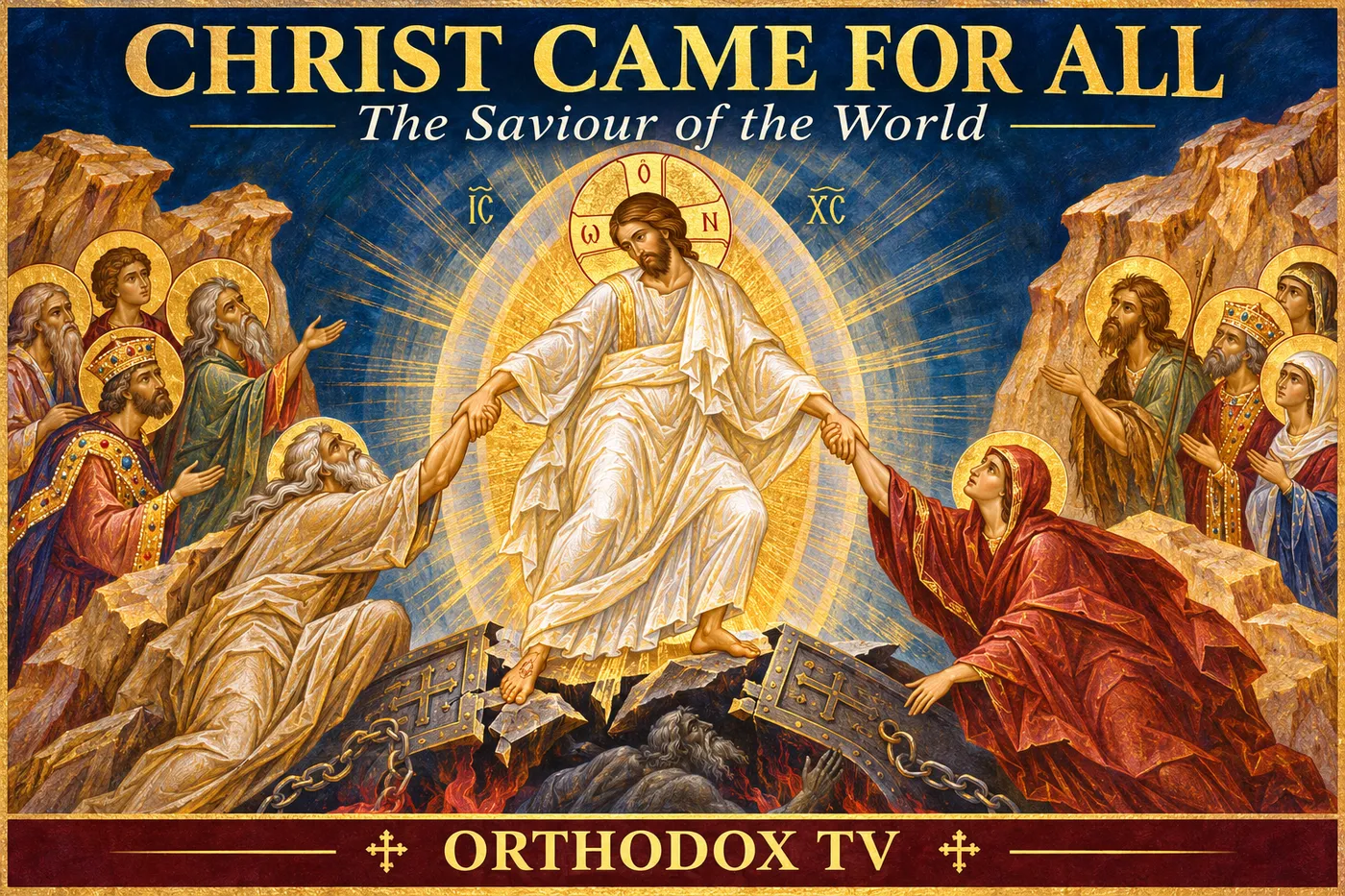
One of the most beautiful expressions of Orthodox theology is the Anastasis icon.
In this traditional Paschal image, Christ descends into Hades, breaks the gates of death, and raises Adam and Eve.
Notice something important.
Christ does not simply emerge from the tomb alone.
He reaches out to fallen humanity.
He takes Adam and Eve by their wrists and raises them from the power of death.
Adam and Eve represent humanity.
Their restoration points to the universal significance of Christ's victory.
The image communicates a profound theological truth:
Humanity cannot rescue itself from death. Christ comes to rescue humanity.
The Anastasis icon is therefore more than a representation of an event in the past.
It is a visual proclamation of the Gospel.
Christ has entered the realm of death and destroyed its power.
This is why Pascha is not merely a celebration of Christ's personal victory.
It is the celebration of the beginning of humanity's renewal.
17. The Indian Church – The Universal Gospel Reaches India
Let us now bring this universal mission closer to our own history.
According to the ancient tradition of the Malankara Orthodox Syrian Church, St. Thomas the Apostle arrived in India in AD 52 and established Christian communities in Kerala.
The traditional account connects his missionary work with the establishment of seven churches.
The historic presence of the Christian community in India is a powerful reminder that the Gospel crossed geographical and cultural boundaries from its earliest centuries.
The Gospel began in the land of Israel.
It spread through Jerusalem, Antioch, Asia Minor, Africa, Europe, and eventually reached India and many other parts of the world.
Think about this:
We are worshipping Christ in a church tradition that traces its apostolic heritage to St. Thomas.
We preserve the Syriac liturgical tradition.
We worship in Malayalam and other languages.
We belong to a Christian tradition rooted in the universal mission of the Apostles.
But we must ask ourselves an important question:
Are we preserving only the heritage of St. Thomas, or are we continuing the missionary spirit of St. Thomas?
Apostolic heritage is not simply something to celebrate.
It is a responsibility to fulfil.
PART V: THE CROSS AND RESURRECTION – THE UNIVERSAL VICTORY OF CHRIST
18. Romans 5:12–21 – Christ, the New Adam
St. Paul presents a remarkable comparison between Adam and Christ.
Through one man's disobedience, sin and death entered human history.
Through the obedience of one Man, Jesus Christ, the gift of righteousness and life becomes available to humanity.
Romans 5:18 declares:
“Therefore, as through one man's offence judgment came to all men, resulting in condemnation, even so through one Man's righteous act the free gift came to all men, resulting in justification of life.”
The theological significance is this:
If the consequences of Adam's Fall affected the whole human family, Christ's saving work must also be understood in its universal scope.
However, this passage should not be interpreted as teaching that every person is automatically saved regardless of faith or response.
Rather, it demonstrates the universal significance of Christ's redemptive work.
19. Hebrews 2:9 – Christ Tasted Death for Everyone
Hebrews 2:9 declares:
“That He, by the grace of God, might taste death for everyone.”
Why did Jesus die?
He did not die for one community alone.
He entered into death, the common enemy of humanity.
Hebrews 2:14–15 explains that through death Christ destroyed the power of the one who held the power of death and delivered those who were enslaved by the fear of death.
Death is a universal human experience.
No nationality can escape it.
No economic status can overcome it.
No cultural tradition can defeat it.
But Christ entered death and conquered it.
This is the heart of the Orthodox Paschal proclamation.
20. 2 Corinthians 5:18–19 – God Reconciled the World to Himself
St. Paul writes:
“God was in Christ reconciling the world to Himself, not imputing their trespasses to them.” (2 Corinthians 5:19)
Notice the language:
God reconciled the world.
This is the language of reconciliation, not exclusion.
Humanity was separated from God through sin.
But God took the initiative to restore the relationship.
And what does God entrust to the Church?
The ministry of reconciliation.
Therefore, the Church is called to become an instrument of reconciliation.
We cannot preach reconciliation with God while encouraging hatred among human beings.
We cannot preach the love of Christ while practising discrimination.
We cannot proclaim the universal Cross while building walls between people.
PART VI: THE UNIVERSAL MISSION OF THE CHURCH – A THEOLOGICAL CHALLENGE
Now we come to a very important question.
If Christ came for all humanity, what is the responsibility of His Church?
There are three theological distinctions we must understand.
21. Universal Redemption Does Not Mean Automatic Universal Salvation
This is perhaps the most important clarification in our discussion.
We must distinguish between three realities.
First: God's universal love.
God loves the world and desires the salvation of all people.
Scripture: John 3:16; 1 Timothy 2:4.
Second: Christ's universal redemptive mission.
Christ offered Himself for the whole world.
Scripture: Hebrews 2:9; 1 John 2:2.
Third: The human response to God's grace.
Human beings are called to respond through faith, repentance, baptism, obedience, and perseverance.
Scripture:
John 3:18 – Belief and unbelief.
Luke 13:3 – Repentance.
Acts 2:38 – Repentance and baptism.
Matthew 24:13 – Perseverance.
The Orthodox Church holds together God's grace and human freedom.
God does not force salvation upon humanity.
He invites us into communion with Him.
We are called to respond to that invitation.
We must also be humble about the final destiny of individuals. The Church proclaims Christ as the one Saviour, trusts in God's mercy and justice, and does not presume to know the final judgment of every human being.
22. Universal Love Does Not Mean All Religions Are Identical
Another important theological clarification is necessary.
When we say Jesus Christ came for all humanity, we are not saying that all religions teach the same truth or that religious differences do not matter.
Christianity makes a clear Christological declaration:
Jesus Christ is the Son of God, the incarnate Word, the crucified and risen Lord, and the Saviour of the world.
Our commitment to Christ does not require us to hate people who follow other religions.
We can respect people of different religious traditions while remaining faithful to our Christian confession.
We can engage in dialogue without abandoning our faith.
We can demonstrate love without compromising our theological convictions.
The Gospel calls us to witness, not hostility.
23. Acts 10 – God Shows No Partiality
One of the most important moments in the history of the early Church is recorded in Acts 10.
Peter visits the house of Cornelius, a Gentile.
This was a significant turning point.
Peter had to confront his own inherited assumptions and understand that God's saving work was not confined to the Jewish community.
He declares:
“In truth I perceive that God shows no partiality.” (Acts 10:34)
This statement has profound implications for the Church today.
God does not show partiality based on race, nationality, language, wealth, or social position.
Galatians 3:28 declares:
“There is neither Jew nor Greek, there is neither slave nor free, there is neither male nor female; for you are all one in Christ Jesus.”
This does not mean that cultural identities disappear.
It means that no cultural or social identity should become a basis for superiority or exclusion within the Body of Christ.
James 2:1–9 goes further and challenges the Church not to give preferential treatment to the rich over the poor.
Here is a question we must honestly ask ourselves:
Can we preach that Christ came for everyone while treating certain people as less important because of their language, financial status, ethnicity, or social background?
Our theology must be reflected in our behaviour.
PART VII: THE MESSAGE FOR THE CHURCH TODAY
24. Preserving Our Cultural Heritage While Embracing Universal Mission
As members of the Malankara Orthodox Syrian Church, we are blessed with a rich spiritual heritage.
We have:
The apostolic tradition of St. Thomas.
The Syriac liturgical heritage.
The Malayalam language and devotional tradition.
The theological wisdom of the Church Fathers.
The beauty of Orthodox worship.
A living sacramental tradition.
These are precious gifts.
But we must understand something important:
Our cultural heritage should become a bridge for the Gospel, not a barrier to the Gospel.
Sometimes our parishes become so focused on preserving language, culture, food, customs, and community identity that we unintentionally overlook the larger mission of the Church.
We must ask ourselves:
Are our churches welcoming to people from different cultural backgrounds?
Are we reaching out to those who do not speak Malayalam?
Are we making space for the younger generation?
Are we welcoming people who are unfamiliar with Orthodox traditions?
Are we serving the wider community beyond our own ethnic group?
A parish should not become merely a cultural association.
It must remain a living missionary community.
We should preserve our traditions while opening our hearts and doors to everyone.
25. Compassionate Service – Making Universal Love Visible
Let us consider Matthew 25:31–46.
Jesus speaks about the hungry, the thirsty, the stranger, the naked, the sick, and the prisoner.
He identifies Himself with those who suffer.
“Assuredly, I say to you, inasmuch as you did it to one of the least of these My brethren, you did it to Me.” (Matthew 25:40)
This passage challenges every Christian community.
If Christ came for all humanity, then our love must also extend to all humanity.
The Church must be concerned about:
The poor and homeless.
The sick and suffering.
Refugees and immigrants.
People experiencing loneliness.
Families facing financial difficulties.
Victims of discrimination.
Those who have no one to support them.
Christian mission is not limited to preaching from the pulpit.
It must be expressed through compassionate action.
Colossians 1:20 speaks of God reconciling all things to Himself through Christ.
Romans 8:19–23 also presents the wider vision of creation awaiting renewal.
Therefore, the Christian understanding of salvation has implications for human dignity, social justice, peace, and our responsibility toward God's creation.
A Church that proclaims universal salvation must demonstrate universal compassion.
PART VIII: SEVEN ESSENTIAL THEOLOGICAL TRUTHS
Let me summarize the central message of this study in seven statements.
1. Christ's love is universal.
God loved the world, not merely one nation or community. (John 3:16)
2. Christ assumed the common human nature of all humanity.
What is not assumed is not healed. (St. Gregory of Nazianzus)
3. Christ's sacrifice has universal significance.
He tasted death for everyone. (Hebrews 2:9)
4. Christ conquered death for humanity.
The Resurrection is the beginning of humanity's renewal.
5. Salvation is participation in divine life.
Through theosis, we are invited into communion with God.
6. The Church has a universal mission.
The Gospel must be proclaimed to all nations. (Matthew 28:19)
7. Human beings must respond to God's grace.
Faith, repentance, baptism, obedience, and perseverance are essential dimensions of Christian life.
THE CROSS HAS NO ETHNIC BOUNDARIES
Beloved brothers and sisters,
Let me conclude with a question:
If Jesus Christ came for all humanity, can the Church afford to live only for itself?
If Christ loved the whole world, can we restrict our love to our own community?
If Christ broke the barriers between Jews and Gentiles, can we continue building barriers based on language, culture, race, and social status?
If Christ reached out to sinners, strangers, and the marginalized, can we ignore those who are suffering around us?
The central message of Christianity is that God did not abandon humanity in its fallen condition.
God entered human history.
He became one of us.
He shared our suffering.
He carried our sins.
He endured the Cross.
He descended into Hades.
He conquered death.
And He rose again, opening the way to eternal life.
This mystery cannot be restricted to one nation, one language, one culture, or one community.
Jesus Christ came for the whole human family.
He came for the Jew and the Gentile.
He came for the rich and the poor.
He came for the powerful and the powerless.
He came for the educated and the uneducated.
He came for the righteous and the sinner.
He came for those who are near and those who are far away.
He came for all humanity.
The Cross is not the victory of one people over another.
The Cross is the revelation of God's saving love for the world.
The Resurrection is not simply the victory of one individual over death.
It is the beginning of the renewal of humanity and the entire creation.
Therefore, the Church must never allow human prejudice to become greater than the love of God.
We must preserve our apostolic heritage, celebrate our liturgical traditions, and remain faithful to Orthodox Christianity.
But at the same time, we must open our hearts to the entire world.
Our mission is not merely to preserve the Church.
Our mission is to proclaim Christ, serve humanity, reconcile people, and become witnesses of God's boundless love.
Let us remember:
The Church belongs to Christ, and Christ came for the world.
The final declaration of our study comes from John 3:17:
“For God did not send His Son into the world to condemn the world, but that the world through Him might be saved.”
May this truth transform not only our theological understanding but also our worship, our parishes, our families, our relationships, and our mission.
Amen.
Discussion and Bible Study Questions
These questions can be used for an Orthodox Bible study, parish discussion, theological seminar, or clergy gathering.
How does John 3:16–17 establish the universal scope of God's love?
What is the significance of the Greek word Kosmos in John's Gospel?
How does St. Athanasius explain the relationship between the Incarnation and the salvation of humanity?
What does St. Gregory of Nazianzus mean by the statement, "What is not assumed is not healed"?
How does St. Irenaeus' theology of Recapitulation connect with Romans 5:12–21?
What is the theological significance of Christ raising Adam and Eve in the Anastasis icon?
How do we distinguish universal redemption from automatic universal salvation?
How does Acts 10 challenge ethnic and cultural discrimination within the Church?
How can the Malankara Orthodox Church preserve its Syriac and Malayalam heritage while developing a universal missionary vision?
What practical responsibilities arise from Matthew 25:31–46?
How does the Orthodox understanding of theosis deepen our understanding of salvation?
What does it mean to be a missionary Church in contemporary multicultural society?
A final message to remember
CHRIST CAME FOR ALL
His Love Has No Boundaries.
His Cross Has No Ethnic Boundaries.
His Resurrection Gives Hope to Humanity.
His Gospel Is for All Nations.
“God was in Christ reconciling the world to Himself.”
2 Corinthians 5:19
The central message: Jesus Christ is not the Saviour of one ethnic or cultural community alone. He is the Saviour of the world. The Church is called not to restrict His love, but to proclaim it, embody it, and share it with all humanity.
A theological accuracy note for presentation: The patristic quotations above are presented as English translations or summaries of the Fathers' teachings. Before publishing this as an academic paper, the exact Greek and Latin quotations and their work/chapter references should be checked against critical editions. Also, the Malankara Church's AD 52 foundation and seven-church tradition should be identified as its received apostolic tradition, rather than presented as independently established archaeological facts. These distinctions will strengthen the credibility of the talk.
FROM THE ORTHODOX TV ARCHIVE
Love God & Love Life.
PASS IT ON
Share this reflection.