LISTEN · കേൾക്കാം
Listen to this article
English audio for this article is not available yet.
Bible Study Address by Very Rev. Sakhariah Ramban
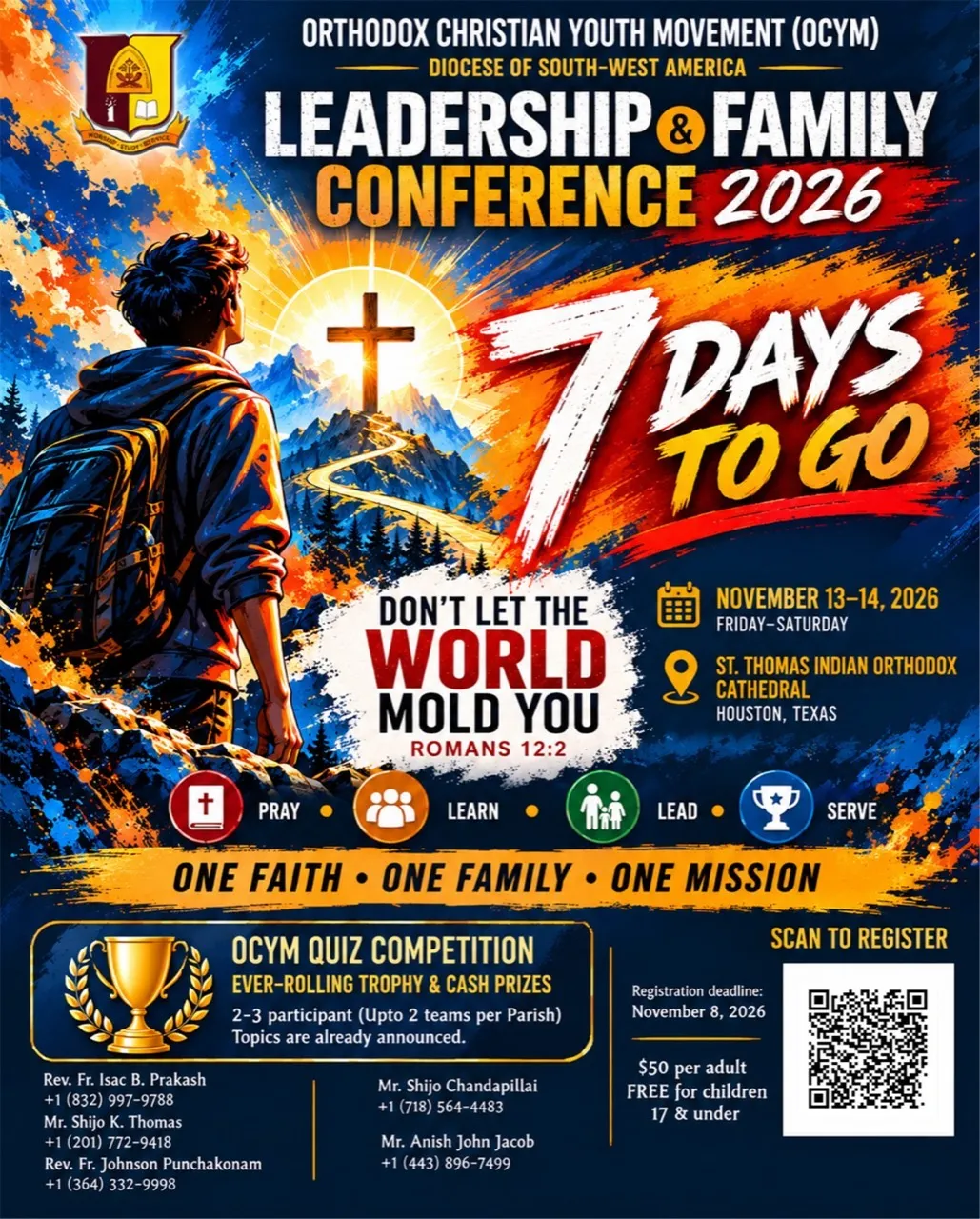
OCYM Diocesan Conference · Diocese of South-West America · St. Thomas Orthodox Cathedral, Houston, Texas
Theme: “I Love, Therefore I Am: Rediscovering Communion with God and One Another”
Key Scripture: “It is not good that man should be alone; I will make him a helper comparable to him.” — Genesis 2:18 (NKJV)
Edited and organized from the supplied conference transcript. Patristic illustrations and interpretive connections are presented as theological reflections rather than verified verbatim quotations.
Introduction: We Are Created for Communion
Dearly beloved in Christ, we are not created to live in isolation. We are created for communion. The God whom we worship is the Holy Trinity—Father, Son, and Holy Spirit—three divine Persons, one divine essence, eternally existing in perfect love and communion. Whether husbands or wives, parents or children, clergy or laity, our lives find their deepest meaning in communion. Christ commands us to love God with all our heart (Matthew 22:37) and our neighbor as ourselves (Matthew 22:39). These commandments cannot be separated.
1. The Holy Trinity: The Perfect Model of Communion
The Father, Son, and Holy Spirit are not three separate gods, but one God in three Persons, united in one divine essence, will, and action. Human relationships do not reproduce the Trinity identically, yet they are called to reflect divine love. “Let Us make man in Our image, according to Our likeness” (Genesis 1:26). Christ prays “that they all may be one” (John 17:21). Our families, marriages, and parishes should express the unity celebrated in the Holy Qurbana. A person cannot claim to draw closer to God while deliberately cultivating hatred or division. The wheel of communion: St. Dorotheos of Gaza compares human relationships to the spokes of a wheel. God is at the center. As each person moves toward the center, all move closer to one another. If we pray but lack compassion, or receive Holy Qurbana while refusing to forgive, our communion is incomplete. Reflection: Does my journey toward God also bring me closer to my family and neighbors?
2. “I Love, Therefore I Am”: The Meaning of Human Existence
René Descartes said, “I think, therefore I am.” Christian reflection invites another formulation: “I love, therefore I am,” and “I am loved, therefore I am.” These are theological reflections, not verbatim sayings of a Church Father. “God is love” (1 John 4:8). Created in God's image, we are called to receive and express His love by grace. Possessions, recognition, career achievements, and status cannot replace genuine communion. We must remove pride, jealousy, resentment, selfishness, and the unwillingness to forgive. The deeper question is: Am I becoming someone through whom Christ's love is revealed?
3. Why Did God Create Eve? The Living Mirror of Communion
God repeatedly calls creation good, but says, “It is not good that man should be alone” (Genesis 2:18). Adam could name the animals, yet none was a suitable human partner. In poetic theological imagery associated with the Syriac tradition, Eve can be understood as a living mirror before Adam: another person through whom he discovers mutual recognition and communion. Eve is not inferior or merely a helper for tasks; she shares Adam's human nature and dignity. “This is now bone of my bones and flesh of my flesh” (Genesis 2:23). Christian marriage is a journey of mutual transformation, in which spouses reflect truth with love rather than humiliation. “Husbands, love your wives, just as Christ also loved the church and gave Himself for her” (Ephesians 5:25). Love is sacrificial and free. The Fall reveals the tragedy of misused freedom, not a defect in the divine gift of communion.
4. Hell as the Refusal of Communion
Imagine people seated back-to-back: physically close but unable to see each other's faces. This monastic-style illustration portrays the tragedy of alienation; it should not be presented as a verified verbatim saying of St. Macarius. Refusal of love and rejection of another person's dignity already manifest spiritual darkness. Families can live under one roof yet remain strangers. Parishioners can receive the same Holy Qurbana yet carry unresolved resentment. Christ calls us to turn toward one another, listen, forgive, and recognize God's image in every person. “We know that we have passed from death to life, because we love the brethren” (1 John 3:14).
5. The Soul Has No Wrinkles: Becoming Like Children
Exercise, nutrition, sleep, and medical care matter for the body. Yet spiritual renewal is possible even as the body ages: “Even though our outward man is perishing, yet the inward man is being renewed day by day” (2 Corinthians 4:16). Poetically, the soul has no wrinkles—not because it is automatically sinless, but because grace can renew it. Every breath can become thanksgiving. Jesus calls us to become like children (Matthew 18:3): not childish or irresponsible, but humble, trusting, open, and ready to reconcile. Children may quarrel and quickly return to play, while adults preserve grievances for decades. “In malice be babes, but in understanding be mature” (1 Corinthians 14:20). Couples married for many years can recover the tenderness, humor, and delight of their early relationship. Holiness produces humility, patience, gentleness, and joy.
6. The Barren Fig Tree: Advertising Life Without Bearing Fruit
Jesus approaches a leafy fig tree and finds no fruit (Mark 11:12–25). Mark notes it was not the season for figs; the incident is a prophetic sign, not merely a complaint about a tree. Outward religious activity, leadership, education, wealth, or professional success cannot substitute for repentance and compassion. After the Fall, Adam and Eve sewed fig leaves to cover themselves (Genesis 3:7). We too hide behind the “fig leaves” of achievements and titles. In Mark, the fig tree narrative surrounds the cleansing of the Temple, which was to be “a house of prayer for all nations” (Mark 11:17). The warning concerns religious appearance without faithfulness. At Christ's death the Temple veil tears (Mark 15:38), signifying the saving significance of His Cross and the access to God opened through Him. Eden's fig leaves, Jerusalem's fruitless tree, and the torn veil are distinct events, but together offer a homiletic movement from hiding toward reconciliation in Christ.
7. The Spiritual Lesson of Autumn: Learning to Let Go
Autumn's falling leaves remind us that visible beauty and worldly security are temporary. Leaves depend on branches, branches on the trunk, and the tree on its roots. Likewise, we are not spiritually self-sufficient. Christ says, “I am the vine, you are the branches” (John 15:5). Through prayer, Scripture, Holy Qurbana, repentance, and love, we abide in Him. The Father's pruning of branches (John 15:2) suggests the transformative discipline of fasting, prostrations, confession, charity, and forgiveness. Sometimes the hardest fast is abstaining from anger; the most meaningful prostration is humbling ourselves before someone we have hurt; the greatest charity is giving time to the lonely. Sometimes spiritual courage means saying, “I was wrong. Please forgive me.”
8. Becoming a Living Mirror: The Christian Family
The journey of Christian life moves from isolation to communion, pride to humility, outward appearances to inward transformation, and selfishness to sacrificial love. Husbands and wives share a calling to faithfulness, holiness, and mutual care. Parents nurture their children in faith as well as material security. Children honor their parents. Parish members recognize one another as members of Christ's Body rather than competitors. “Be kind to one another, tenderhearted, forgiving one another, even as God in Christ forgave you” (Ephesians 4:32). Let homes become places where forgiveness is practiced and disagreements invite humility.
9. The Holy Qurbana: The Fulfillment of Communion
The Eucharist is not merely an individual spiritual experience. It is the Church's sacramental communion with Christ and, in Him, with one another. “For we, though many, are one bread and one body; for we all partake of that one bread” (1 Corinthians 10:17). The peace exchanged in the liturgy must become peace practiced at home. The forgiveness we seek from God must become forgiveness extended to others. The grace of Holy Qurbana must continue in our speech, relationships, and service after we leave the church.
10. Questions for Personal and Group Reflection
- Am I growing closer to God while also growing closer to the people around me?
- Do I recognize my spouse and family members as persons created in God's image?
- Am I willing to forgive quickly, or do I carry old resentments?
- Does my outward Christian identity reflect genuine spiritual fruit?
- What are the fig leaves behind which I hide my weaknesses?
- What must I surrender so Christ can transform my life?
- Do I approach Holy Qurbana with a sincere desire for reconciliation?
- How can I become a living mirror of Christ's love this week?
Conclusion: From the Image of God to the Likeness of Christ
Dear brothers and sisters, we are created in the image and likeness of God, and called to grow in the likeness of Christ through the Holy Spirit's transforming grace. This is theosis—participation in divine life by grace. The closer we move toward God, the closer we must become to one another. Let us not become leafy trees without fruit. Let our marriages bear sacrificial love, our families forgiveness, our parishes unity, and our youth faith, service, and holiness. The question is not merely whether we have lived successfully, but whether we have learned to love as Christ loves. “I am loved by God; therefore, I am called to love.” May the Holy Trinity—Father, Son, and Holy Spirit—guide us into deeper communion with God and one another. Amen.
Conference Bible Study Summary
Central message: The human person, created in the image of the Triune God, finds fulfillment in loving communion with God and others. Marriage, family life, spiritual discipline, forgiveness, and Holy Qurbana should lead to genuine transformation and spiritual fruit.
Key themes: Trinitarian communion; the creation of Eve; image and likeness of God; marriage; childlike humility; barren fig tree; repentance; ascetic discipline; theosis.
FROM THE ORTHODOX TV ARCHIVE
Love God & Love Life.
PASS IT ON
Share this reflection.