LISTEN · കേൾക്കാം
Listen to this article
English audio for this article is not available yet.
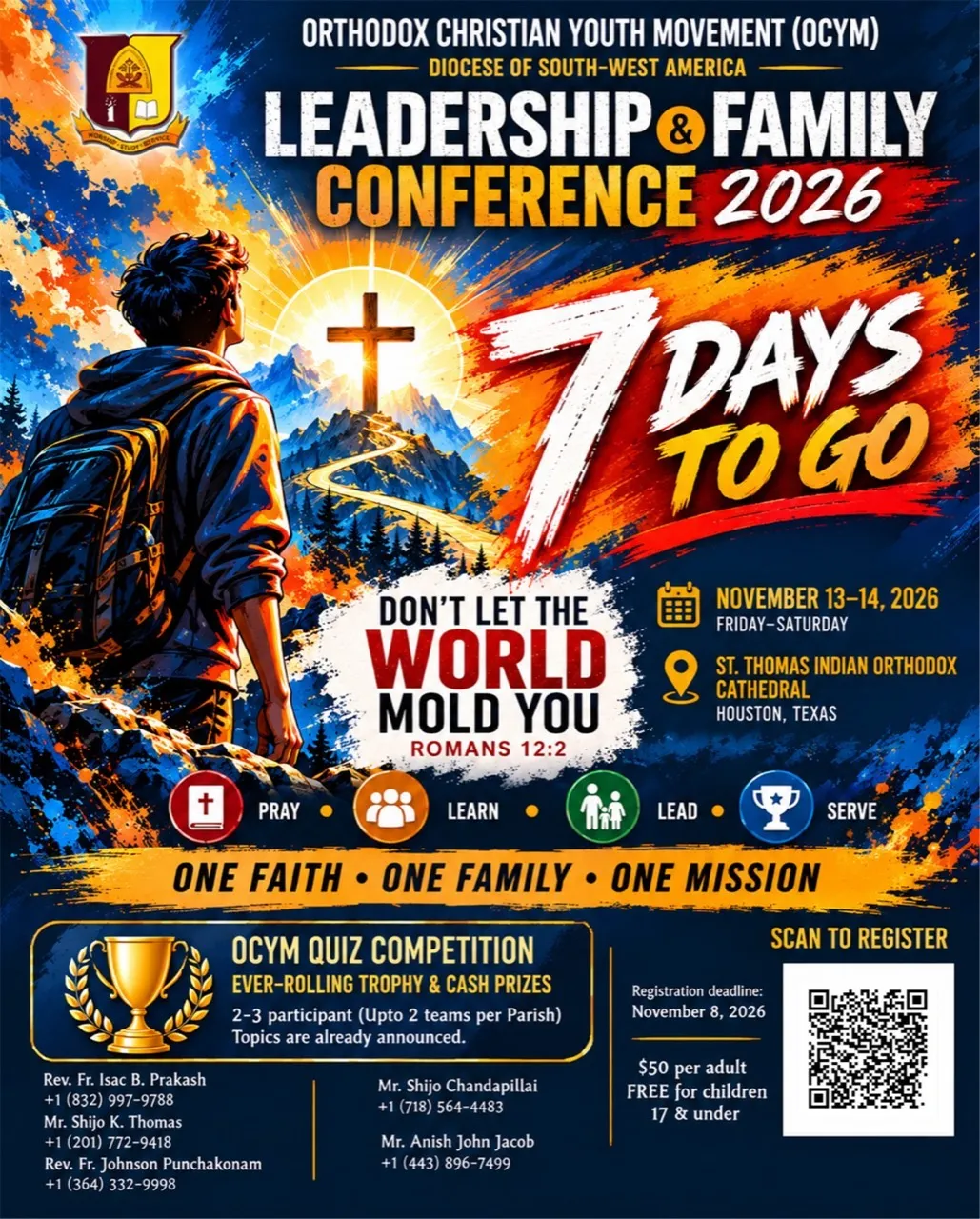
OCYM Inaugural Address by H.G. Dr. Thomas Mar Ivanios Metropolitan
Knowledge, Information, or Formation? — A Call to Sit at the Feet of Jesus Christ
Respected clergy, distinguished guests, beloved brothers and sisters in our Lord Jesus Christ,
Greetings to all of you in the precious name of our Lord and Savior Jesus Christ.
As we gather on this blessed occasion, I would like to place before you a very important question:
What do we really need in our lives today? Is it knowledge? Is it information? Or is it formation?
We are living in a world where knowledge is expanding rapidly. Information is available everywhere. With the advancement of science, technology, and modern communication, we can obtain information about almost anything within seconds.
But there is a fundamental question we must ask ourselves:
Are we becoming better human beings because of all this information? Are we becoming more spiritual, more compassionate, more loving, and more Christlike?
Information alone cannot transform a human being.
Knowledge may enlighten our minds, but spiritual formation transforms our hearts.
The purpose of Christian life is not merely to acquire information about God. It is to be transformed into the likeness of God.
1. We Are Created in the Image and Likeness of God
In the Book of Genesis, we read: “So God created man in his own image, in the image of God created he him.” — Genesis 1:27
This is the foundation of our Christian understanding of human life. Every human being is created in the image of God. Our existence is not an accident. Our life has a divine purpose. God has created us with the capacity to reflect His love, goodness, holiness, and compassion.
However, being created in God’s image also places upon us a great responsibility. We must grow in His likeness. The image of God is a divine gift, but growth in the likeness of God requires spiritual discipline, prayer, obedience, repentance, and communion with Him.
Therefore, Christian education must not stop with the accumulation of biblical or theological information. It must lead us toward spiritual formation. The ultimate goal of our Christian life is the transformation of our whole being into the likeness of Jesus Christ.
As Saint Paul teaches: “Be ye transformed by the renewing of your mind.” — Romans 12:2
This transformation is the true purpose of Christian formation.
2. Information Is Not the Same as Spiritual Formation
Today, we have an abundance of information. We know many things about the world. We understand technology, science, economics, politics, and countless other subjects. We may even know a great deal about the Bible, the Church, theology, and Christian traditions.
But knowing about Christ is not the same as knowing Christ personally. A person may know hundreds of Bible verses and yet fail to practice forgiveness. Someone may understand the theology of love but remain unable to love a neighbor. Another may possess extensive knowledge about prayer but never spend meaningful time in prayer.
This is the difference between information and formation.
Information fills the mind. Formation shapes the character.
Information tells us what Jesus taught. Formation helps us live according to His teachings.
Information explains the meaning of holiness. Formation leads us toward a holy life.
Information gives us knowledge about God. Formation brings us into a living relationship with God.
Our Orthodox Christian tradition has always emphasized this deeper spiritual transformation. We do not come to the Church simply to learn religious facts. We come to participate in the life of Christ through prayer, worship, the Holy Sacraments, and Christian fellowship.
3. Martha and Mary: A Lesson for Our Generation
Let us turn our attention to a beautiful incident recorded in the Gospel according to Saint Luke, chapter 10, verses 38–42. Jesus entered the house of Martha and Mary.
Martha was busy preparing and serving. She was deeply concerned about providing hospitality to Jesus. Mary, on the other hand, chose to sit at the feet of Jesus and listen to His words. Martha became anxious because Mary was not helping her. Finally, Martha approached Jesus and complained.
But Jesus answered: “Martha, Martha, thou art careful and troubled about many things: But one thing is needful: and Mary hath chosen that good part, which shall not be taken away from her.” — Luke 10:41–42
My beloved brothers and sisters, this is a powerful message for our generation. Martha was not doing something wrong. Her service was important. Hospitality was necessary. But in the midst of her many responsibilities, she became distracted and anxious.
Mary understood something essential. She recognized that the most important thing at that moment was to sit at the feet of Jesus and listen to His voice.
This brings us to a question that each of us must answer: Are we living like Martha, or are we learning to sit at the feet of Jesus like Mary?
We are all busy. We have responsibilities in our families, churches, workplaces, and communities. We have meetings to attend, programs to organize, and countless tasks to complete.
But how much time do we spend sitting quietly in the presence of God? How often do we open the Holy Bible, not merely to gather information, but to listen to what God is speaking to our hearts? How often do we allow the Word of God to correct our attitudes, guide our decisions, and transform our lives?
4. The Greatest Challenge of the Modern World: Noise
We are living in an extremely noisy world. There is noise everywhere. Our mobile phones are constantly ringing. Messages and notifications demand our attention. Television, social media, and digital platforms fill our minds with endless information.
We are connected to the whole world, yet sometimes we are disconnected from our own spiritual lives. We have time to listen to hundreds of voices, but we often struggle to find a few moments to listen to the voice of God.
Technology has brought extraordinary opportunities into human life. We should appreciate these developments and use them responsibly. But technology must never become a substitute for our relationship with God.
We must learn to distinguish between what is useful and what is essential. Jesus reminds Martha that only one thing is ultimately necessary. That one thing is communion with God.
In the midst of our busy schedules, we must create space for silence, prayer, and reflection. The Psalmist reminds us: “Be still, and know that I am God.” — Psalm 46:10
Without spiritual stillness, our hearts become restless. Without prayer, our activities can lose their spiritual direction. Without listening to God, even our religious responsibilities may become mechanical.
5. We Must Learn to Sit at the Feet of Jesus
Mary’s example is especially relevant to Christians living in the modern technological world.
Sitting at the feet of Jesus means more than physically sitting in one place. It means developing an attitude of humility, attentiveness, obedience, and spiritual openness. It means recognizing that the Word of God must guide our lives. It means making prayer and Scripture central to our daily existence.
We must ask ourselves: Do we begin our day with prayer? Do we spend time reading and meditating upon the Holy Scriptures? Do we listen to God’s voice before making important decisions? Do we allow Christ to shape our relationships, priorities, and ambitions?
The Lord Jesus Christ says: “My sheep hear my voice, and I know them, and they follow me.” — John 10:27
Listening to the voice of Christ is not merely an intellectual exercise. It is a spiritual discipline that leads to obedience and transformation. We must listen not only with our ears, but with our hearts.
6. Spiritual Formation Brings Peace and Happiness
One of the greatest problems of modern humanity is the absence of inner peace. People may possess education, wealth, professional achievements, and social recognition, yet still experience anxiety, loneliness, and spiritual emptiness.
Why? Because material success alone cannot satisfy the deepest longing of the human heart. Our hearts were created for communion with God.
When we sit at the feet of Jesus, we begin to experience a peace that the world cannot provide.
Jesus says: “Peace I leave with you, my peace I give unto you: not as the world giveth, give I unto you.” — John 14:27
The peace of Christ is not dependent upon favorable circumstances. It is rooted in our relationship with Him.
When our lives are formed by the Word of God, we develop patience in difficulties, courage in suffering, compassion toward others, and hope in times of uncertainty. This is the fruit of spiritual formation.
7. Our Christian Calling: From Information to Transformation
My dear brothers and sisters, we must remember that the purpose of Christian life is not merely to become knowledgeable individuals. We are called to become transformed individuals.
The Church is not simply an institution for transmitting religious information. The Church is the Body of Christ, where believers are nurtured and formed in the life of the Holy Spirit.
Our Sunday Schools, youth ministries, Bible studies, family prayers, and parish activities must all contribute to this spiritual formation.
Our children should not merely memorize biblical facts. They must learn to love Jesus Christ. Our young people should not merely understand Orthodox theology. They must experience the beauty of Orthodox spirituality.
Our families should not merely observe religious customs. They must become living communities of prayer, love, forgiveness, and mutual respect.
Our spiritual growth must be reflected in our daily conduct. As Saint James teaches: “But be ye doers of the word, and not hearers only.” — James 1:22
The Word of God must become visible in our lives.
8. Conclusion: Choose the Better Part
As I conclude this presidential address, I would like to return to the question with which we began: What do we need most—knowledge, information, or formation?
Knowledge is important. Information is necessary. But spiritual formation is essential.
We need knowledge that leads to wisdom. We need information that leads to understanding. Above all, we need spiritual formation that leads us into the likeness of Jesus Christ.
Let us remember the words of our Lord to Martha: “One thing is needful.”
In the midst of our responsibilities, ambitions, achievements, and daily struggles, let us never forget that one essential thing.
Let us find time to sit at the feet of Jesus. Let us listen to His Word. Let us allow His teachings to transform our minds, purify our hearts, and guide our actions.
May our homes become places of prayer. May our churches become communities of spiritual formation. May our children and young people grow not only in knowledge but also in wisdom, holiness, and love.
And may each one of us grow daily into the likeness of our Lord and Savior Jesus Christ.
Let us not be satisfied merely with knowing about Christ. Let us seek to know Christ, follow Christ, and become more like Christ.
May the grace and peace of our Lord Jesus Christ be with you all.
Thank you. God bless you.
FROM THE ORTHODOX TV ARCHIVE
Love God & Love Life.
PASS IT ON
Share this reflection.